
Searching for the best tile leveling system turns up dozens of kits that look alike in photos but work in different ways. The real choice is not a brand; it is a mechanism. There are three main types: clip-and-wedge, spin cap, and strap-and-cap. Each one handles pressure, reuse, speed and joint width differently. This guide explains how each type works, which parts are reusable, which suit tight joints and large format tile, and how to pick the right type for your job.
What types of tile leveling systems are there?
There are three common types of tile leveling system: clip-and-wedge, where a wedge is pushed through a break-off clip; spin cap, where a cap is screwed down a threaded post; and strap-and-cap, where a flexible strap is pulled through a cap. All three use a disposable base under the tile and a reusable top part.
Every type, also called an anti-lippage system, does the same basic job: a base plate sits under the edges of two neighboring tiles, a part above the tile face applies downward pressure, and the base pulls up against the tile undersides until both faces are in one plane. They differ in how that pressure is applied and how you remove the hardware afterward.
How does a clip-and-wedge system work?
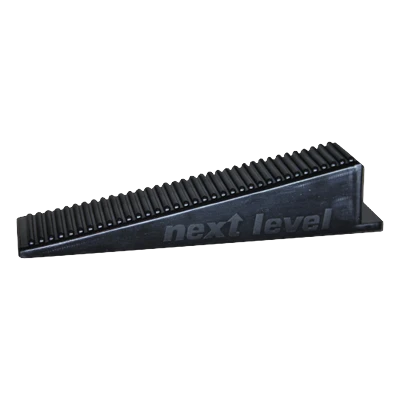
In a clip-and-wedge system, a clip goes under the tile edges and a tapered wedge slides through a window in the clip. Pushing the wedge in, by hand or with leveling pliers, presses both tiles down evenly. After the mortar cures, the clip snaps off at its break point.
The clip body also sets the joint width, so one part handles spacing and leveling. The wedge is reusable; the clip is single use. The method is fast because there is nothing to thread: you place clips as you set each tile, then push wedges along the row. Tension is controlled by how far the wedge goes in, so a consistent hand or a pair of pliers gives consistent results. The Next Level clip-and-wedge tile leveling system uses this design, with clips in 1/32, 1/16 and 1/8 inch and reusable wedges.
How does a spin-cap system work?
In a spin-cap system, the base has a threaded post that sticks up through the joint. A cap is spun down the post until it presses on both tiles. The cap is reusable, the post and base are single use, and the post is snapped off after the mortar cures.
Spin caps let you dial in pressure gradually, and many installers like being able to back a cap off and retighten it. Some kits use a cap tightening tool to speed up spinning, and some caps have a disc under them, an anti-friction shield, so the cap turns without scuffing the tile face. The trade-off is time: spinning each cap takes longer than pushing a wedge on big jobs. For a named comparison, see our page Next Level vs. Spin Doctor.
How does a strap-and-cap system work?
A strap-and-cap system uses a base with a flexible strap that runs up through the joint and through a cap or lock on top. Pulling the strap tight, often with a tool, presses the cap onto the tiles; the strap is then cut or snapped off after the mortar cures.
Strap systems work like a cable tie: tension is applied by pulling and held by the lock. They can be quick once you get the rhythm and some give fine control. The base and strap are single use; caps are usually reusable. Because each design is different, check the maker’s instructions for tension and removal.
Which parts are reusable in each type?
In all three types the base under the tile is single use because it stays in the mortar. The top part is the reusable piece: wedges in clip-and-wedge systems, caps in spin-cap and most strap systems. A single-use system throws away everything; a reusable system lowers cost per job over time.
| System type | Single-use part | Reusable part | Tightened with | Removal |
|---|---|---|---|---|
| Clip-and-wedge | Clip (base plate and break-off body) | Wedge | Hand or leveling pliers | Kick or tap the clip top in line with the joint |
| Spin cap | Base with threaded post | Cap | Hand or cap tool | Unscrew cap, snap post |
| Strap-and-cap | Base with strap | Cap or lock (most designs) | Pulling tool or hand | Cut or snap strap |
When you compare cost per job, count the single-use parts per square foot for your tile size and spread the reusable parts across all the jobs you expect to do. A tile leveling kit that looks cheap can cost more if every part is thrown away.
Which type fits 1/16″ joints and large format tile?
All three types are used on large format tile. For tight joints, the deciding factor is the thickness of the part that sits in the joint: a clip-and-wedge system with a 1/16 or 1/32 inch clip sets that joint directly, while some posts and straps need a minimum joint width to pass through.
Check the smallest joint each product supports before you buy. With a clip system the clip body is the spacer, so the joint size is printed on the clip. Next Level clips come in 1/32 inch (1 mm), 1/16 inch (1.5 mm) and 1/8 inch (3 mm). For big tile, also check the supported tile thickness range: the Next Level product page lists tile between 1/4 and 7/16 inch thick. Which joint to choose is a separate decision covered in 1/16 vs 1/8 grout line; keep in mind that many tile makers set a minimum joint for their product.
Which system should you choose for your job?
Choose by job profile: a clip-and-wedge system for speed on floors and walls and for joints from 1/32 to 1/8 inch; a spin-cap system if you prefer gradual, adjustable pressure; a strap system if you like pull-tension control. For most pros and DIYers, joint size and cost per job decide it.
- Production floors and walls: clip-and-wedge is the fastest to place and tighten, and the wedges carry over to the next job.
- First-time DIY bathroom: any type works; pick one whose clip matches the joint you want and buy enough clips for the square footage.
- Thin porcelain or very large tile: choose a system rated for your tile thickness and place clips closely enough that edges cannot flex between them.
- Frequent re-adjusting: spin caps allow backing off pressure without removing hardware.
Whatever you pick, the substrate still has to be flat. A leveling system controls the edges between tiles; it does not fix a floor with humps and dips. Our article on tile leveling tools covers the pliers, mallets and straightedges that go with each system, and the tile leveling system brand comparison looks at specific brands.
Frequently asked questions
What are the best tile leveling clips?
The best clips break cleanly below the tile surface, come in the joint width you need, and fit your tile thickness. Clean breakage matters most, because a clip that snaps high leaves plastic in the joint.
Are spinning tile levelers better than wedges?
Not better, different. Spinning levelers offer adjustable pressure; wedges are faster to install. Both prevent lippage when used correctly.
Do I need special pliers?
Not always. Many wedge systems can be set by hand, and leveling pliers make the tension more consistent and save your hands on large jobs.
Key terms
- Clip-and-wedge system: a leveling system where a tapered wedge pushed through a clip presses adjacent tiles into one plane.
- Spin cap: a reusable cap screwed down a threaded post to press tiles flat.
- Threaded post: the screw-like part of a spin-cap base that rises through the joint.
- Strap-and-cap system: a leveling system that tensions a flexible strap through a cap, like a cable tie.
- Reusable cap: the top piece of a spin-cap or strap system that is kept and used again.
- Disposable clip: a single-use clip or base that stays under the tile and is broken off after curing.
- Leveling pliers: a hand tool that pushes wedges or pulls straps to a consistent tension.
- Base plate: the flat bottom of a clip or base that sits under the edges of two tiles.
- Break point: the designed weak line where a clip snaps off below the tile surface.
- Anti-lippage system: another name for a tile leveling system.
- Tile leveling kit: a package of clips or bases plus wedges or caps, sometimes with a tool.
- Anti-friction shield: a disc under some spin caps that lets the cap turn without scuffing the tile face.
- Cap tightening tool: a driver or wrench used to spin caps down quickly and evenly.
- Cost per job: the single-use parts consumed on one job plus a share of the reusable parts.
- Single-use system: a leveling system in which every part is thrown away after one installation.
- Reusable system: a leveling system whose top parts, such as wedges or caps, are kept for future jobs.
Settled on clip-and-wedge? Next Level ships clips in three joint sizes and reusable wedges nationwide, sold by quote. Get a quote for the Next Level tile leveling system with your tile size and square footage.